

Email Domain Authentication
Verify the sending domain, account-specific authentication records and delivery of a controlled Supportbench reply.
Required for your chosen channel: email with your domain · Connect support channels
Verify that Supportbench is authorized to send using your chosen email domain and that a real test message reaches its destination. A saved reply identity or enabled signing switch is not a delivery test.
SPF identifies permitted sending infrastructure. DKIM signs mail so a recipient can verify the sending domain. A bounce domain is used for the return path of delivery failures. Your domain administrator should use the current account-specific instructions for the sending arrangement you choose.
Before you begin
Have an approved reply address, the administrator responsible for DNS, and a controlled external recipient. DNS is the domain configuration where email-authentication records are published. Do not copy another account’s values, an old screenshot or the fictional northstar.example domain into live DNS.
Supportbench’s email authentication and delivery reference is the canonical starting point. Confirm the current records with Supportbench Support and your domain administrator.
Inspect the sending identity
- Open Settings → Email configuration → Address / signature.
- Open the approved outgoing address and confirm its actual domain and display name.
- Review Custom DKIM DNS setup if custom signing is the agreed method.
- TXT host and TXT value appear when Enable custom DKIM is on. To inspect an unfinished setup, you can switch it on without saving. If the value says Provided by Supportbench Support, it is a placeholder. Obtain the real value from Supportbench Support; do not publish that sentence as DNS.
- Cancel any inspection-only changes. Save the enabled state only after the real DNS and sending-side setup are verified. The switch does not create DNS or verify the key.
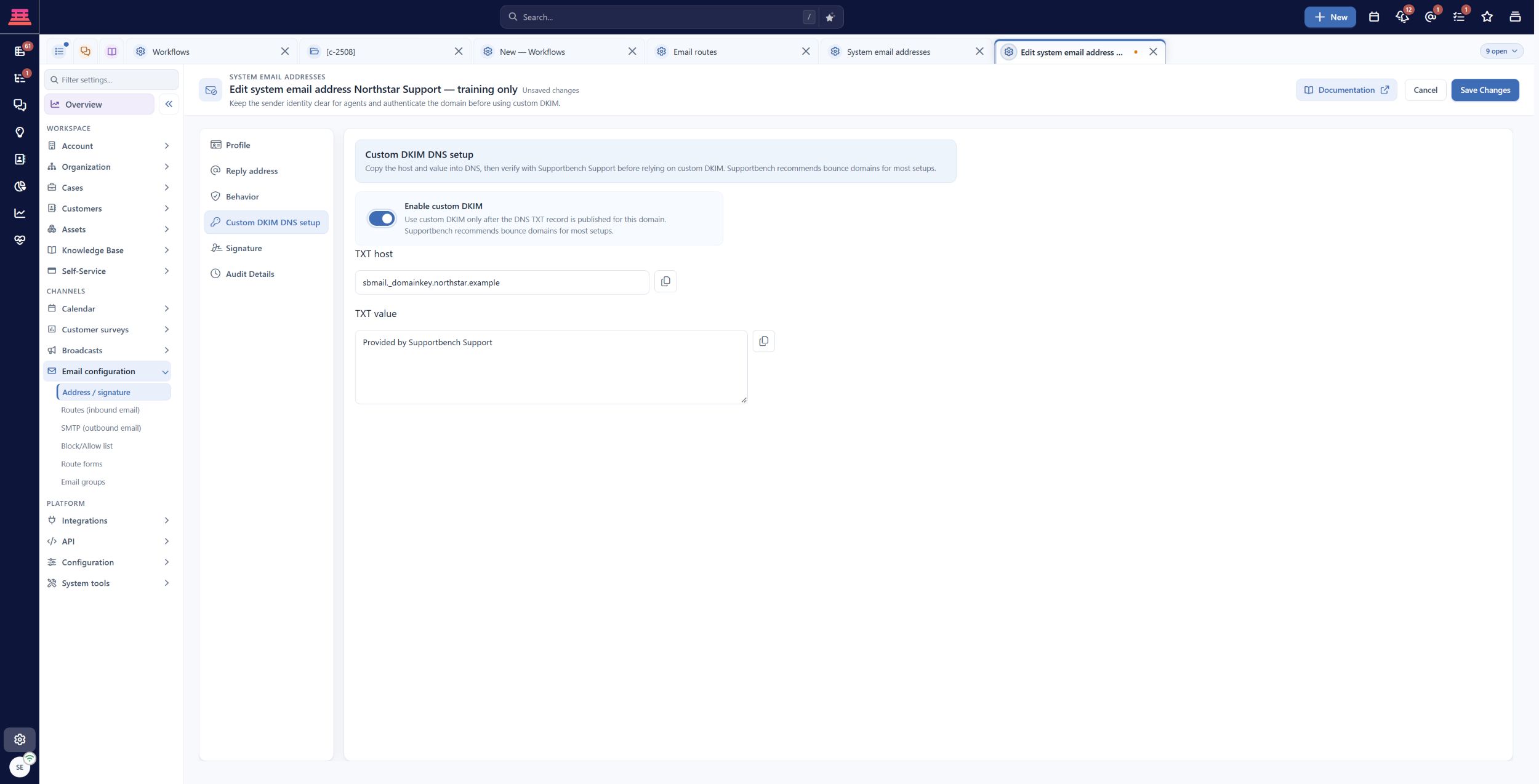
Unsaved inspection of custom DKIM on the inactive fictional identity. Provided by Supportbench Support is a placeholder, not a DNS value.
Supportbench recommends bounce domains for many setups. Use the agreed current method rather than enabling every authentication option. Reply-address authentication controls explains what this screen does.
Apply and verify the agreed records
- Give the domain administrator the exact approved record type, host and value for this account and sending domain.
- Have that administrator review existing mail records before changing anything. Existing mail senders must continue to work.
- Have them publish the agreed records through the domain’s DNS provider and verify that the authoritative DNS returns the intended values.
- Allow for the provider’s DNS propagation/caching behavior. Record the change and verification time.
- Confirm sending-side readiness with Supportbench. If custom DKIM is the chosen method and setup is verified, enable it on the correct reply identity and save.
- Reopen the identity and confirm its saved state.
This walkthrough does not provide a universal DNS value: the correct value depends on your account and domain. The basic task is complete only when the responsible administrators have supplied and verified the exact values.
Test actual delivery
- Open the controlled Harbor training case.
- Select the intended Reply Address and an authorized test recipient. Review the body and every recipient.
- Send a harmless test message.
- In the recipient mailbox, confirm arrival, sender identity and the provider’s message-authentication results in the message details/headers.
- Reply from the test mailbox and verify the message returns to the same case through the incoming route.
- Record the test result separately from the configuration save.
Do not send to [email protected]: it is fictional. If no controlled destination is available, keep delivery verification pending.
Troubleshoot the actual failure
- TXT value is a placeholder: obtain the real value; do not guess a key.
- Authentication fails: compare the actual sending domain, returned DNS records and message-header results with the agreed setup.
- Mail arrives in spam: inspect authentication, sender identity and recipient-provider handling; a signing toggle alone does not establish inbox placement.
- Mail arrives but replies do not return: inspect inbound mailbox forwarding and route matching separately.
- A previous sender stops working: have the domain administrator review the changed records and existing senders before making further unrelated changes.
Completion check
- The sending domain and authentication method are agreed.
- Account-specific DNS and sending-side settings are verified.
- A controlled message’s authentication and arrival were checked.
- Its reply returns to the intended case.
- Any provider or delivery dependency remains explicitly pending.
Previous: Email Routes, Reply Addresses and Signatures · Next: Community Portal
Updated 20 days ago