

Your Account
Set the identity of the organization providing support and make dates and times understandable to your team.
Required · Start here
Set the identity of the organization providing support and make dates and times understandable to your team. The result is an account agents can recognize and regional settings the administrator has reviewed.
Before you begin
Use an administrator with permission to edit account configuration and policies. Have your business name, business address, approved branding and working timezone ready. Account means your Supportbench workspace; a company is a customer you add later. In this example, Northstar Software owns the account and Harbor Manufacturing is a customer.
Keep existing values that are already correct. Changing the account’s software version, subscription or DNS (the domain-name records managed by your domain administrator) is outside basic onboarding.
Set your organization identity
- Open Settings → Account → Configuration / Style.
- On Organization, review Name, Address, City, Zip / Postal code, Country and the relevant state or province field. Enter your organization’s details. For the fictional walkthrough, the name would be Northstar Software; do not use a customer’s company name here.
- Select Save Changes. Wait for the save result before leaving.
- Reopen Configuration / Style → Organization and confirm that your intended values remain. If they do not, resolve the validation message and save again before proceeding.
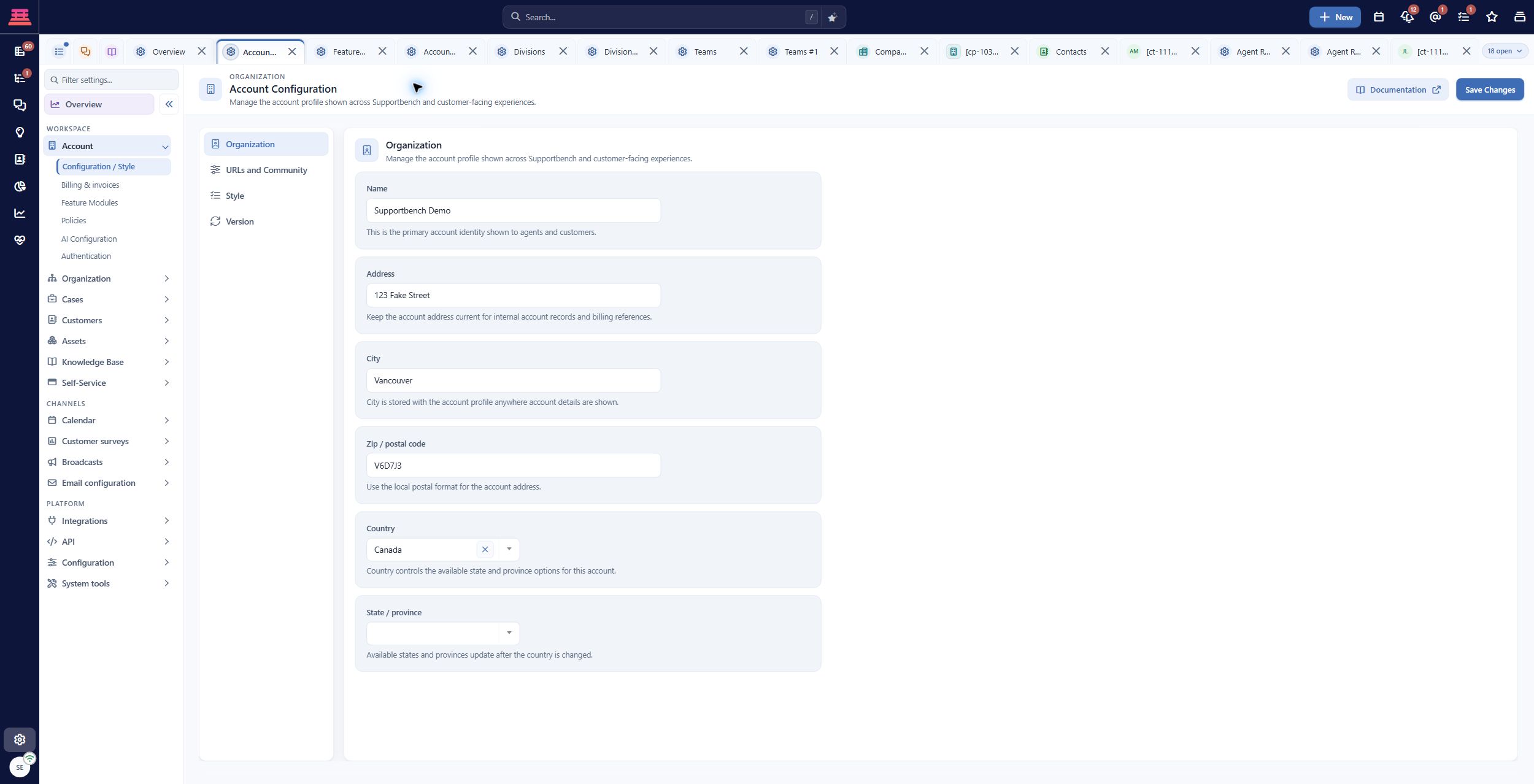
Existing demo account identity in Organization. Northstar Software is the fictional organization used in the written example.
The screenshot is a saved demo account. It shows where your own details belong; its displayed address is not a required default.
- Review URLs and Community only after deciding which customer community will be used. A community is the customer-facing portal experience. Keep an existing working URL while onboarding; custom domains require separate DNS planning. Account details, branding and community defaults explains these options.
- Review Style if you have approved brand assets. Keep the current style if your team is not ready to choose branding. Uploading a logo does not configure email routing or customer access.
- Save any intentional style change and check it in the workspace. Leave Version unchanged for this Core onboarding journey.
Review dates, times and personal settings
- Open Settings → Account → Policies → Regional Settings.
- Review Date Format, Time Format, Timezone and Country code. Choose an unambiguous date format and the timezone your team expects. Northstar might use its main office timezone; that is an example choice.
- Select Save Changes if you changed a value. The date and time controls explain that users need to sign out and back in for those changes to take effect. Arrange this after saving other work.
- Check a date and time in the refreshed workspace. Do not assume that the account timezone establishes every team’s working hours; those are configured separately.
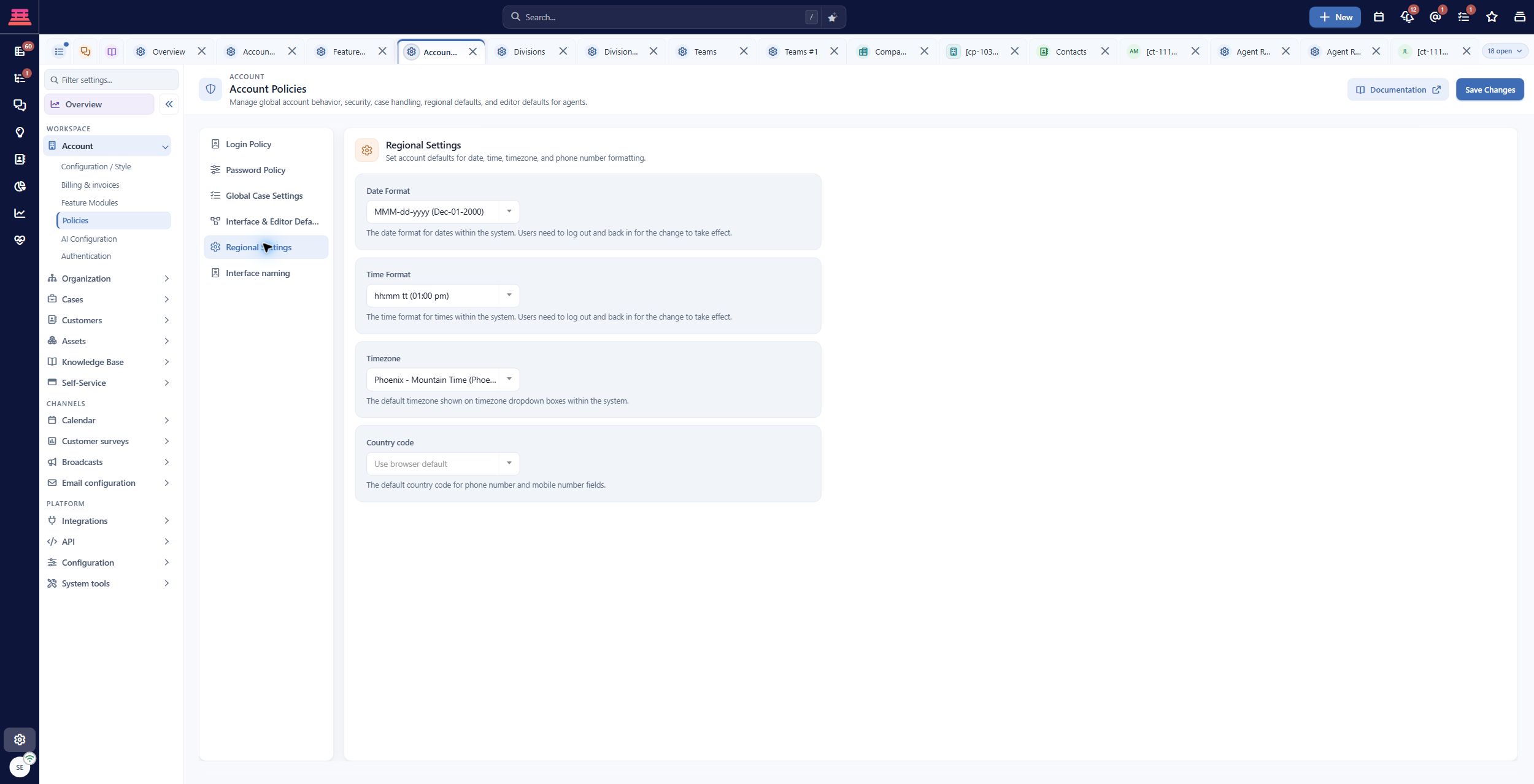
Saved Regional Settings. Verify the timezone rather than copying these demo values.
An agent’s profile, availability and team membership are separate from account-wide policy. Ask each agent to verify their own profile and availability during the staff setup chapter. Use agent profiles and availability for the detailed settings.
Choose carefully
Account policies affect the whole account. Preserve existing login and password protection while learning the product. Do not turn on an SSO-only login policy before a working sign-in method and recovery path have been verified. The full account policies reference explains the scope of each policy.
If your business uses several timezones, document which timezone each team’s hours use. A displayed timestamp, an agent’s availability and an SLA calendar answer different questions.
If something does not work
- Save Changes is missing or disabled: have an administrator check your configuration permissions. Do not work around access by using another person’s login.
- A value disappears after reopening: read the field validation message, correct the specific field and save again. Confirm the saved result before editing another section.
- Dates still use the old format: save other work, sign out and back in, then compare the same record.
- A logo or style is unclear: restore the last approved asset through the same form, save, and inspect it at normal reading size.
- You entered Harbor as the account name: correct the account identity here, then add Harbor under Customers in the later chapter.
Completion check
- The account identifies your support organization.
- The administrator has reviewed regional settings.
- Saved values survive reopening the screen.
- Agents know that their profile and team calendars are separate.
- Optional branding and custom-domain work has an owner if deferred.
Previous: Understand Supportbench concepts · Next: Modules and Policies
Updated 30 minutes ago