

Assets and Asset Categories
Link supported products or installations to customers when your process needs asset records.
Optional · Configure case handling
Use assets when a support request needs a record of the product, installation, device or other supported item involved. An asset category groups similar assets. An asset is the particular item. You may skip this chapter when company, contact and case details are sufficient.
Before you begin
Enable the required Assets capability only if your process needs it, and use an administrator with category and asset permissions. Decide what an asset represents in your business. Northstar might track Harbor’s Reporting workspace so cases retain the relevant installation context. That is an example model, not a requirement to turn software customers into hardware inventory.
Create or review the category
- Open Settings → Assets → Categories.
- Inspect existing categories. Select New Category only when none fits.
- Reuse a suitable category such as the demo’s Software assets. If you need a separate category, enter a clear name such as Customer workspaces, with a description explaining what belongs there.
- Review the parent and division scope. A child category inherits its hierarchy’s scope; do not assume it is globally available.
- Review active state and applicable visibility settings.
- Select Save Changes, reopen the category and verify its scope.
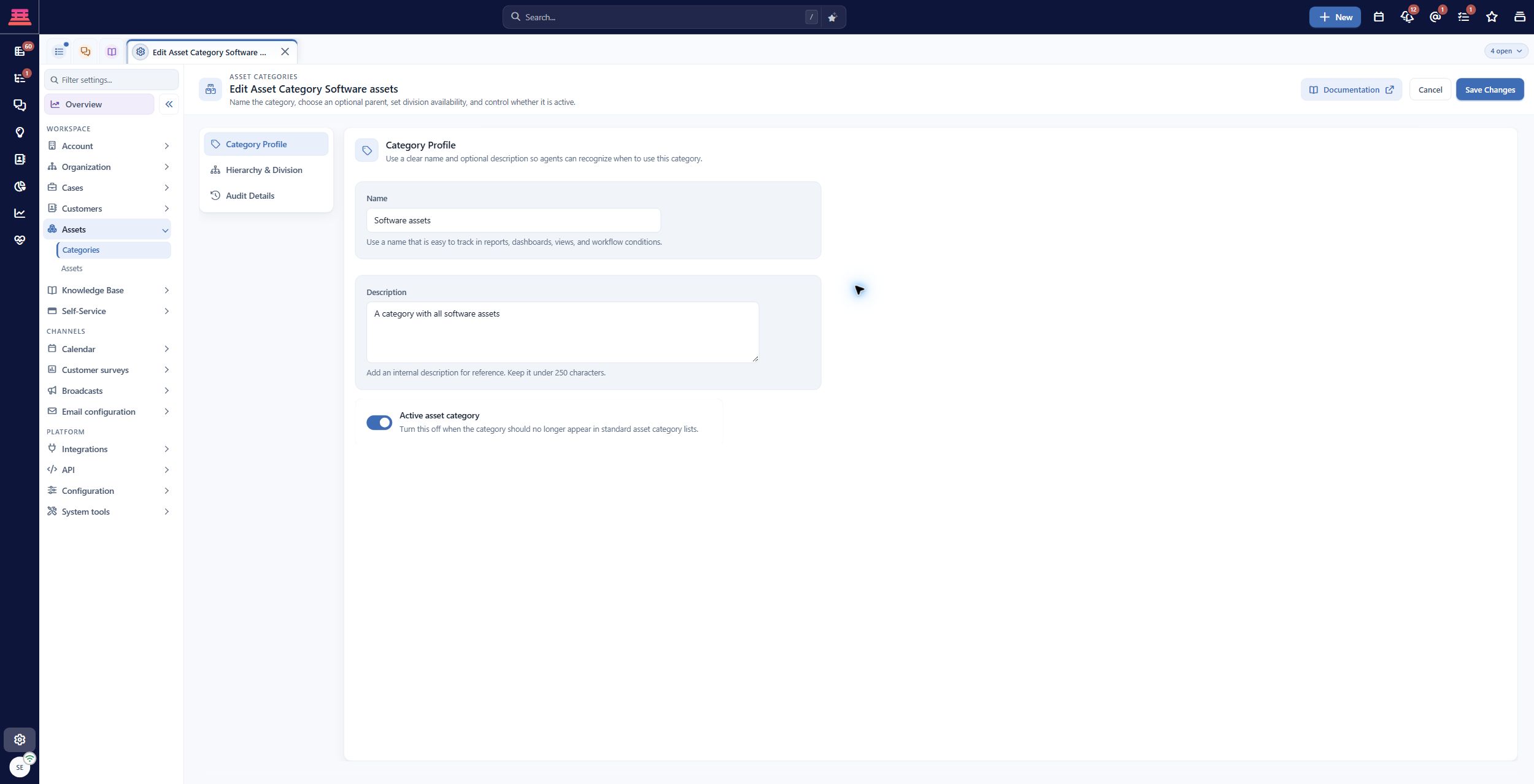
Existing saved Software assets category. Reuse an appropriate category before adding another.
Asset categories explains the hierarchy and available settings.
Add the specific asset
- Open Settings → Assets → Assets and select New Asset.
- Enter a recognizable name such as Harbor — Reporting workspace.
- Select the appropriate category and fill only the identifiers your support team actually uses. Use fictional values for practice.
- Review Visibility and Active. The screenshot uses Internal Only for a training item; choose the audience your actual process needs. Customer association and visibility are separate decisions.
- Select Save Asset. The saved editor exposes Linked companies, Linked contacts and Audit.
- Open Linked companies, use Search companies to find Harbor Manufacturing, and select the result. The association saves immediately; confirm Harbor appears in the linked list. Use Linked contacts similarly if the asset needs a specific person.
- Reopen the saved asset and confirm its details and associations. On the training case, select the asset where the case form exposes it and verify the saved case association.
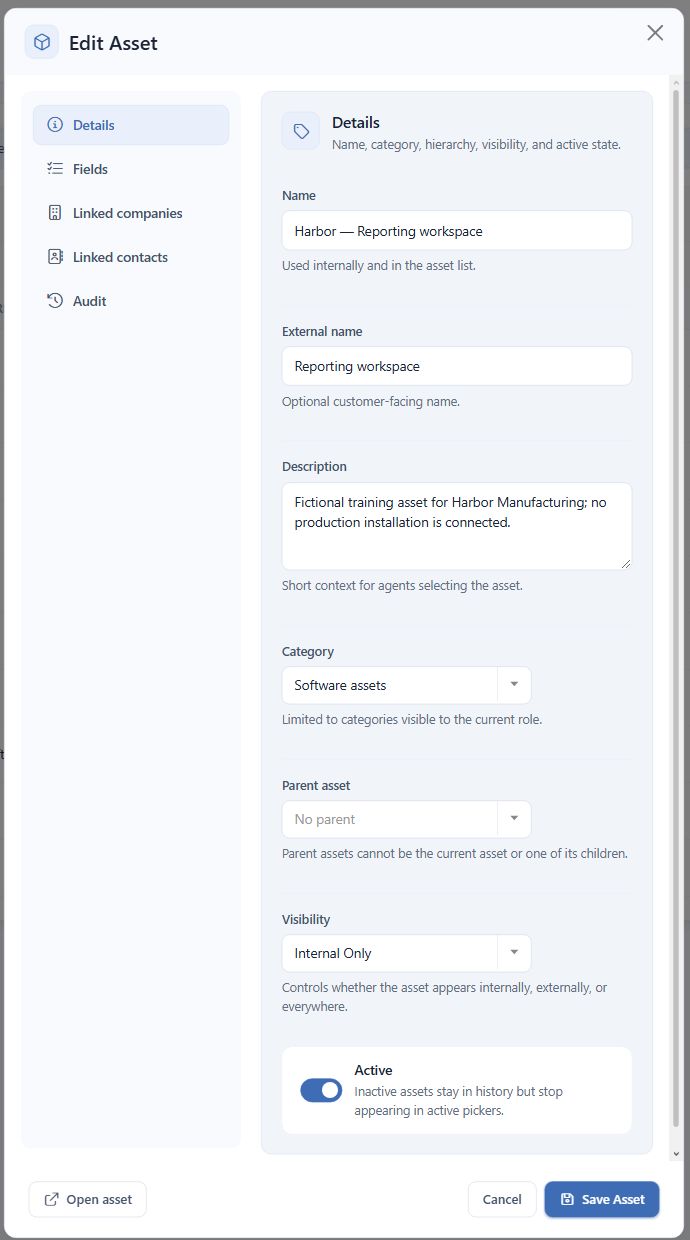
Saved Harbor — Reporting workspace asset in Software assets, with Internal Only visibility for this training example.
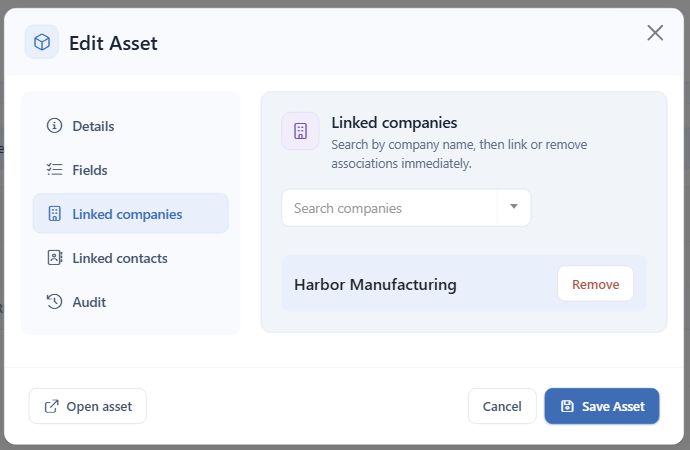
Saved Linked companies association for Harbor Manufacturing; these links save immediately.
See asset records, customer associations and visibility for the full reference.
Decide what information belongs here
Store stable item-specific information on the asset. Store the details of this failure—what Jordan attempted, the error and the investigation—on the case. Store the person’s contact information on the contact. This prevents each case from becoming another inconsistent copy of the same customer installation.
If the case form does not expose assets, review the relevant case policy rather than assuming the asset was not saved. Do not require an asset on every case if many legitimate requests do not concern one.
Verify and recover
Confirm that an intended agent can find the asset and attach it to the Harbor case. If customers should see it, test as the intended customer; also test an unrelated customer who should not.
If a category or asset is missing, check module availability, active state, division scope and role access. If the wrong company was linked, correct the association in the asset editor and recheck the case. If an identifier already exists, inspect the existing item before creating a duplicate.
If your team cannot explain who maintains the asset or how it helps resolve cases, leave this optional setup deferred with an owner rather than adding unused records.
Completion check
- The asset model has a clear operational purpose, or the chapter is deliberately deferred.
- Category scope and customer association are correct.
- The saved asset is available on the intended case form.
- Audience access is verified separately from association.
Previous: Issues · Next: Custom Fields
Updated 2 days ago