

Adding Your First Queues
Create a clear destination for incoming work. A queue holds cases for a group to monitor and can distribute them automatically when configured. A queue is not an individual owner a
Required · Organize your support team
Create a clear destination for incoming work. A queue holds cases for a group to monitor and can distribute them automatically when configured. A queue is not an individual owner and is not the same as a team.
Before you begin
An administrator needs queue-management permission. Have a suitable team and at least one eligible agent. Northstar will use Support Queue as its example queue for Harbor’s report-export requests. Reuse an existing suitable queue when possible.
The result is a monitored queue with deliberate membership. Automatic assignment is optional.
Configure the queue
- Open Settings → Organization → Queues. Open a suitable queue or select New Queue.
- Enter Name and Description. Use a purpose such as “First review of Northstar customer support requests.”
- Choose a Team, or deliberately choose Global queue if it should not be limited to one team. Selecting Global clears the team selection; these are alternatives.
- Leave Parent queue empty for a simple setup. Review Display order and keep the queue active.
- Enable Chat queue only if this queue will receive chats. The chat widget still needs its own routing setup and coverage.
- Review the queue’s Timezone, Working days and Working hours. Match the real receiving team. Add off-day coverage only where staffed.
- Select Save Changes, reopen the queue and confirm the saved scope and schedule.
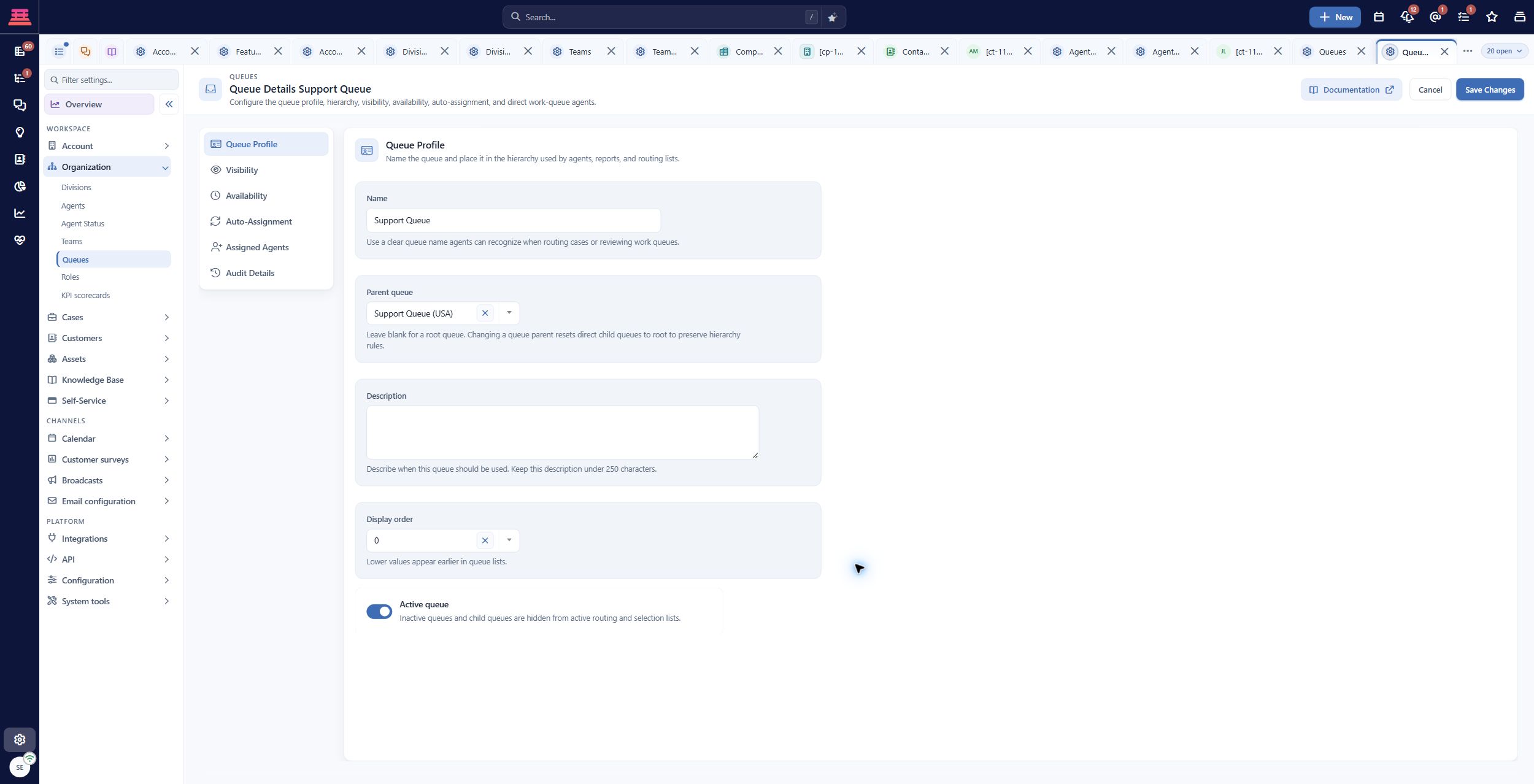
Saved Support Queue profile. This existing demo queue is a child queue; a new root queue can leave Parent queue empty.
Add the people who will monitor it
- Open Assigned Agents in the queue.
- Use Add agent to select the staff responsible for monitoring this work. Team membership alone is not proof of direct queue membership.
- Save where the screen presents Save Changes, reopen the membership view and confirm the intended agents.
- Ask an intended agent to open Queues in the main navigation and locate the queue.
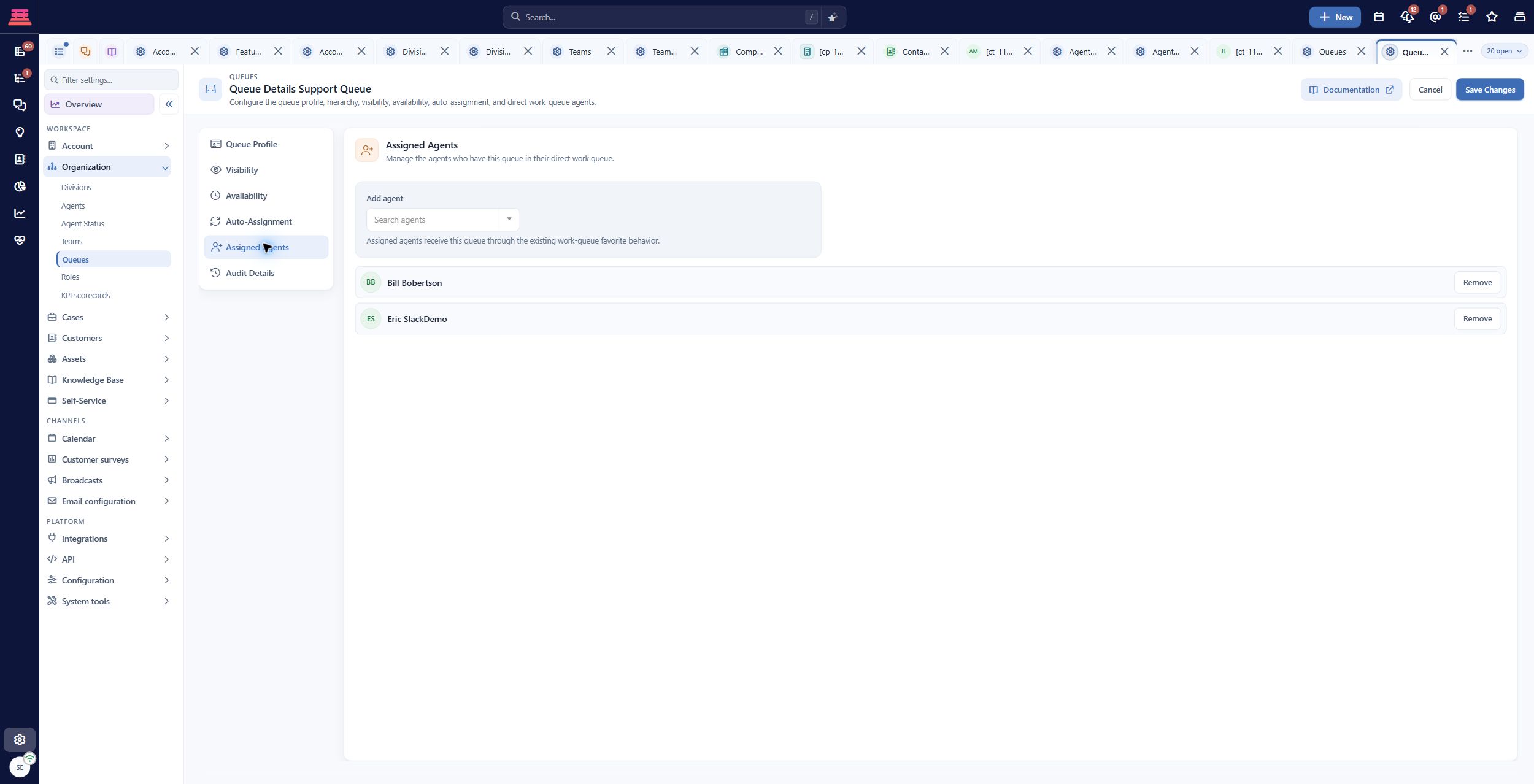
Assigned Agents on the existing demo Support Queue. Direct queue membership is separate from round-robin assignment.
If the agent is being created in the next chapter, record this membership as unfinished and return immediately after the profile is ready.
Decide whether to automate assignment
Start with an explicit manual monitoring process if that fits a small team: an agent checks the queue, takes responsibility and handles the case. Do not leave the queue unmonitored while expecting automation that has not been enabled.
For automatic distribution, open Auto-Assignment, enable Enable round robin, and choose the actual participating agents or teams. Review Availability rule: Availability, Just working hours, or Availability and working hours. Check Use queue hours, workload and asset-owner options only when they serve your process. Save and test the result.
Assigned Agents and round-robin participants are separate lists. Presence, calendars, out-of-office status and working hours can affect eligibility differently. An Away indicator alone is not a universal stop for case assignment. Queue membership, schedules and automatic assignment explains the detailed behavior.
Verify with the training case
Assign “Monthly report export fails” to the queue using the case assignment control. Confirm the queue shown on the case and that an intended agent can find it. If round robin is enabled, observe the resulting owner and test a second controlled case under a different availability condition. Do not infer successful routing from a saved configuration form.
If work is missing or unassigned
- Queue absent from a picker: check active state, Team/Global choice, agent team membership and role access, then reopen the picker.
- Case stays in the queue: confirm whether round robin is enabled, whether participants are configured and whether any are eligible under the saved rule.
- Wrong final owner: inspect other workflows and route settings that may change assignment after intake.
- Queue exists but nobody sees work: verify both membership and the case’s actual queue; merely creating the queue does not route email into it.
Completion check
- The queue has a clear purpose and receiving team.
- At least one agent can monitor it.
- Manual ownership or automatic assignment is explicitly chosen.
- A controlled case reaches the queue and its next owner.
Previous: Defining User Roles · Next: Adding Your Agents
Updated 16 days ago