

Adding Your Agents
Give each staff member an individual agent account, an appropriate role and a clear place in the support operation. An agent works for your support organization. A Harbor customer
Required · Organize your support team
Give each staff member an individual agent account, an appropriate role and a clear place in the support operation. An agent works for your support organization. A Harbor customer contact belongs under Customers and does not need an agent seat.
Before you begin
Use an administrator with Create new agents and the appropriate agent-profile administration permissions. Confirm that your subscription has capacity for the intended staff; do not buy seats merely to follow the example. Have the staff member’s approved business identity, role, division, primary team and queue ready.
Create or review an agent
- Open Settings → Organization → Agents.
- Search for the staff member before creating a duplicate. Open an existing profile, or select New Agent.
- In Identity and assignment, enter Email, First name and Last name. Use a real controlled staff address for an invitation; example addresses in this guide will not onboard a person.
- Review Assignment & routing. Choose the intended Division, Role, Primary team and, where appropriate, Manager.
- Add only the necessary Secondary teams and Work queues. For Northstar’s support agent, confirm membership in the queue receiving Harbor’s cases.
- In Settings → Login & access, review Active, which controls sign-in and assignment. Return to Profile to review the schedule, and use Out of office for planned absences. An active account, a presence status and an out-of-office schedule are different things.
- Select Save profile. Reopen it and verify the role and memberships.
- If Send password link? appears, select Send link only for the intended controlled staff address, or Do not send to defer onboarding. The link lets the staff member complete their own password setup. Complete your account’s configured sign-in process with them. They should set or enter their own credentials through that process; do not share an administrator login.
The screenshots use fictional Sam Taylor, saved Inactive for documentation without a password email. An actual staff member must be active, use their approved business address, and complete their own sign-in test.
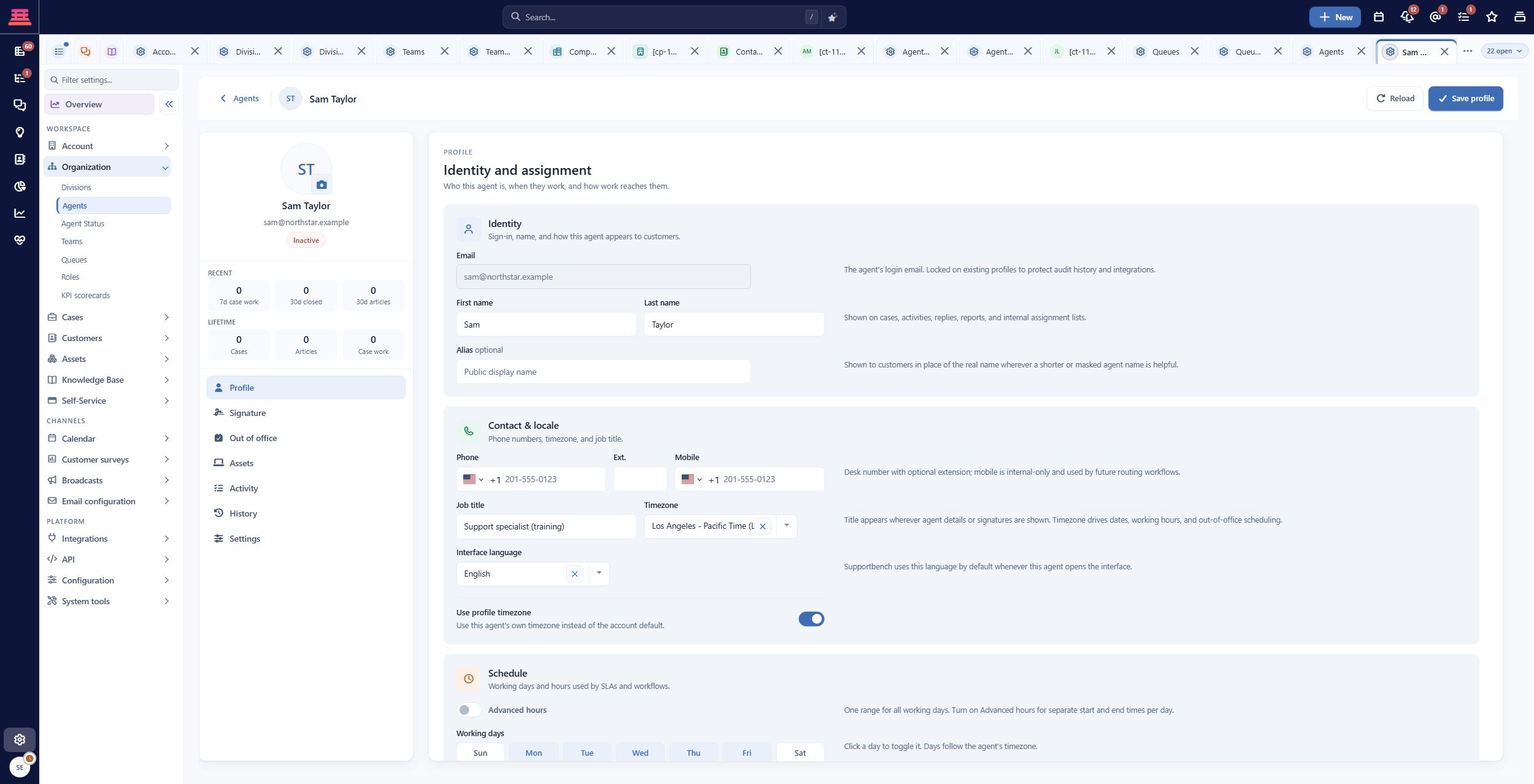
Saved fictional Sam Taylor profile. This documentation-only agent is Inactive and no password email was sent.
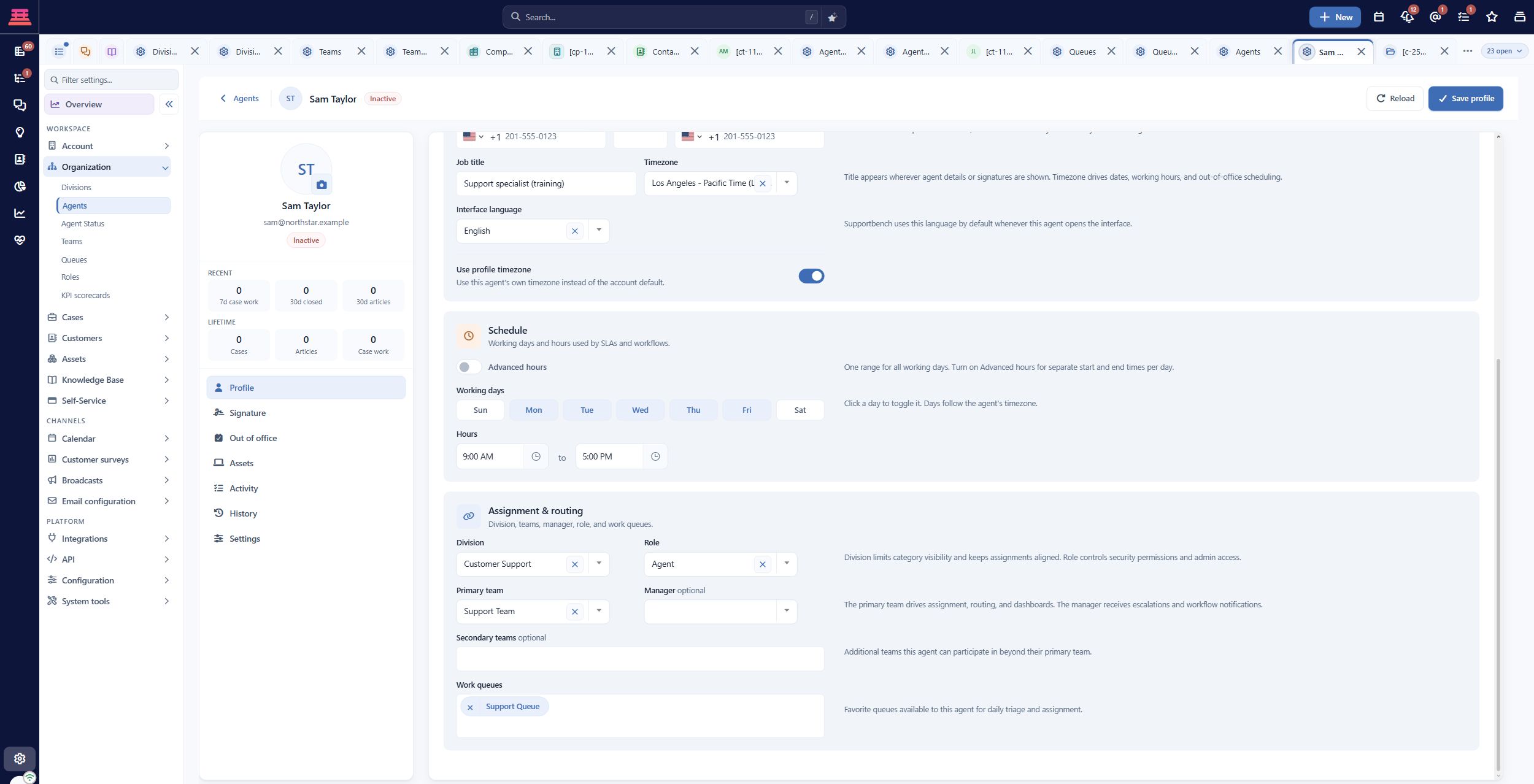
Saved fictional Sam Taylor profile: schedule and assignment to Customer Support, Agent role, Support Team and Support Queue. Inactive status is intentional for documentation.
Agent profiles, access and availability covers the detailed fields and account variations.
Complete the agent’s first sign-in
- Ask the agent to sign in to the correct account address.
- Have them review their profile and timezone, working availability and any approved email signature options available to their role.
- Open Cases and Queues. Confirm that the intended support queue is visible.
- Open the controlled “Monthly report export fails” case when it is available. Confirm the customer context and the permitted reply, note and assignment actions.
- Ask the agent to locate the daily-work guide: Start your day and keep support work moving. Agree who checks unassigned queue work and who covers absences.
A successful sign-in is only the first check. A staff member may be able to enter the workspace while still lacking the role, queue membership or record access needed for their job.
Make deliberate access choices
Use the reviewed support role from the previous chapter. Add broader permissions only for a concrete responsibility. Keep each staff member’s access individual so assignment and history remain meaningful.
Review direct queue membership as well as team membership. If automatic assignment is used, check the queue’s round-robin participant list separately. Queue assignment rules explains why an active agent may still be ineligible.
Recover common problems
- New-agent controls are missing: check creation permission and subscription capacity with the account administrator.
- Invitation or sign-in fails: verify the account address and approved business email, then use the configured invitation/recovery process. Do not create repeated duplicate profiles.
- Role or team is absent: confirm that the configuration record is active and within the administrator’s permitted scope.
- Agent can sign in but cannot work the queue: check role, division scope, team and direct queue membership. Save corrections, have the agent refresh or sign in again, and retest the same case.
- Agent receives no automatic work: inspect round-robin participants, availability rules, calendar and out-of-office state.
Completion check
- Each staff member has an individual agent profile.
- The role, division, team and queues are verified.
- Sign-in and actual case access have been tested.
- Availability and absence coverage are understood.
- Deferred invitations or capacity work has an owner.
Previous: Adding Your First Queues · Next: Add companies and contacts
Updated 14 days ago