

Email Routes, Reply Addresses and Signatures
Configure incoming support email, outgoing reply addresses and signatures, then test case creation and replies.
Required for your chosen channel: email · Connect support channels
To get support emails into Supportbench, configure an incoming route and forward your approved mailbox to its generated destination. To reply, configure an outgoing identity. These are separate records: the route receives mail; the reply address is the sender customers see.
How do I get support emails into Supportbench?
Create an inbound email route, then configure your support mailbox to forward incoming messages to the route’s generated address. Choose the receiving division and queue, and send a controlled test message to your normal support mailbox. The steps below cover both the incoming route and the reply address customers will see.
Before you begin
Use an administrator permitted to manage inbound routes and Administer outbound email addresses. Have access to the approved shared mailbox through its administrator, a monitored queue, and a controlled test mailbox. Example [email protected] is fictional and must not be entered as a working delivery address.
Configure incoming email
- Open Settings → Email configuration → Routes (inbound email).
- Open a suitable route or select New Route. Enter a recognizable name and description for the support mailbox.
- Open Case defaults. Select Division: Customer Support, Priority: Medium and Queue: Support Queue for the fictional example. Your choices must match your real coverage. Leave Email forms empty unless you already use a structured email form.
- Open Matching rules and review Match by message references and Match by subject. Message references help keep replies on the existing case. Subject matching needs testing when unrelated messages have the same subject.
- Open Contact handling and decide whether Create missing contacts fits the mailbox. Review Use forwarded sender as contact against the actual forwarding format; the customer should not become the shared mailbox itself.
- Save the route and reopen it. Copy the generated read-only Forwarding address exactly.
- Have the mailbox administrator configure forwarding to that destination. Do not substitute your outgoing reply address for the generated destination. Preserve spam filtering and the original sender/reference information.
- On Route details, confirm Active route is enabled only when the mailbox is ready to use. The training screenshot leaves it off because no provider forwarding or delivery test was performed.
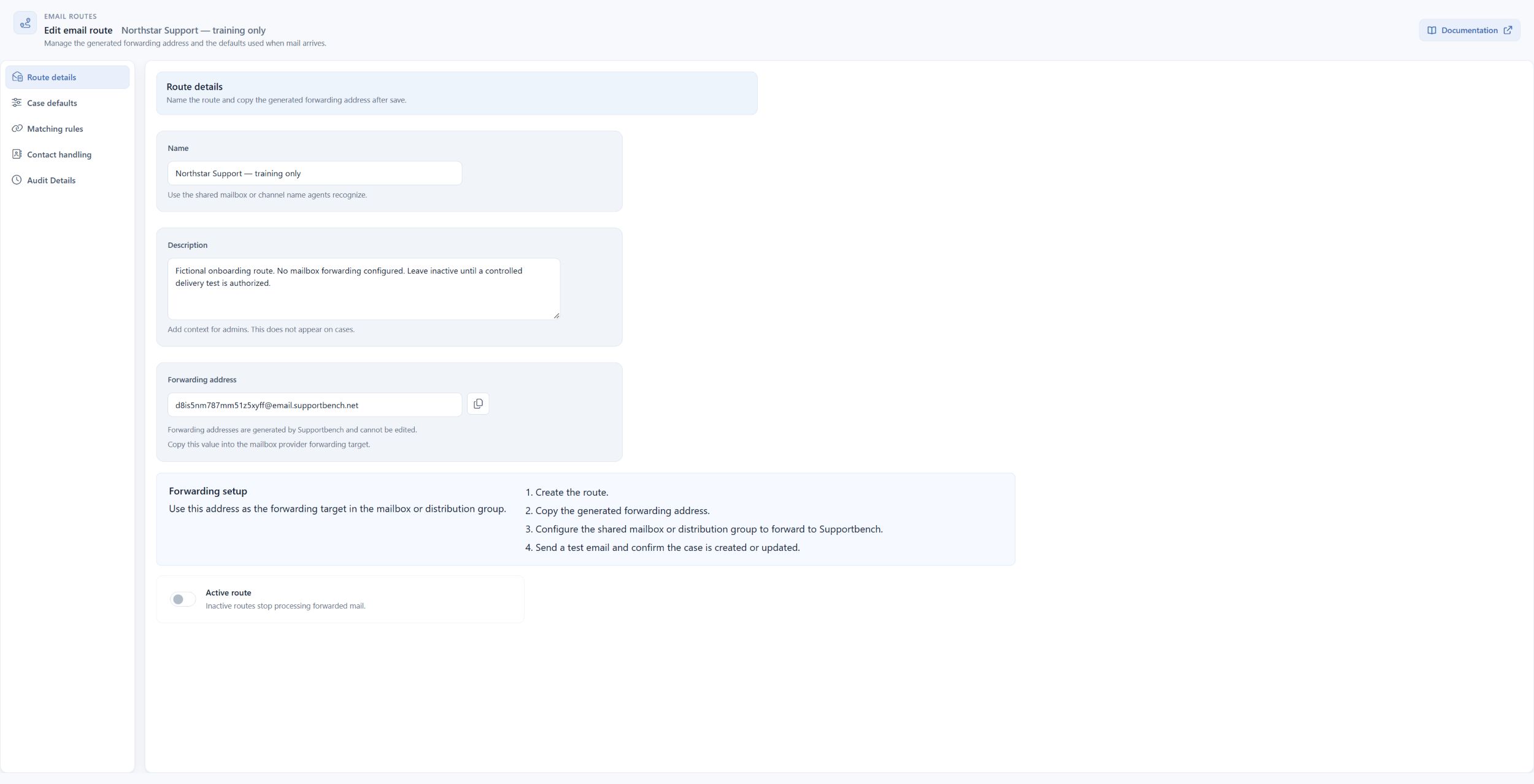
Saved inactive Northstar training route. Do not copy its generated address into a real mailbox.
Inbound routing and matching and Microsoft 365 forwarding guidance provide provider-specific detail.
Configure the outgoing identity
- Open Settings → Email configuration → Address / signature. The page heading is System email addresses.
- Select New Address, or open an existing approved identity.
- In Profile, enter Name and Description for agents to recognize. Keep Active off for an unfinished or fictional training identity.
- Under Reply address, enter the real approved Email address and customer-facing Display name, such as Northstar Support.
- Check the email carefully before the first save: the saved address is locked. A future mailbox change requires a replacement identity.
- In Behavior, review Default active address. Use the account default only for the intended general sender; a specialized identity need not replace it. Review Active in Profile before making the identity available.
- Open Signature and enter a concise sign-off, such as “Northstar Software Support,” plus the approved contact route. Check for duplication with templates and agent signatures.
- Save, reopen and confirm the sender, display name and signature.
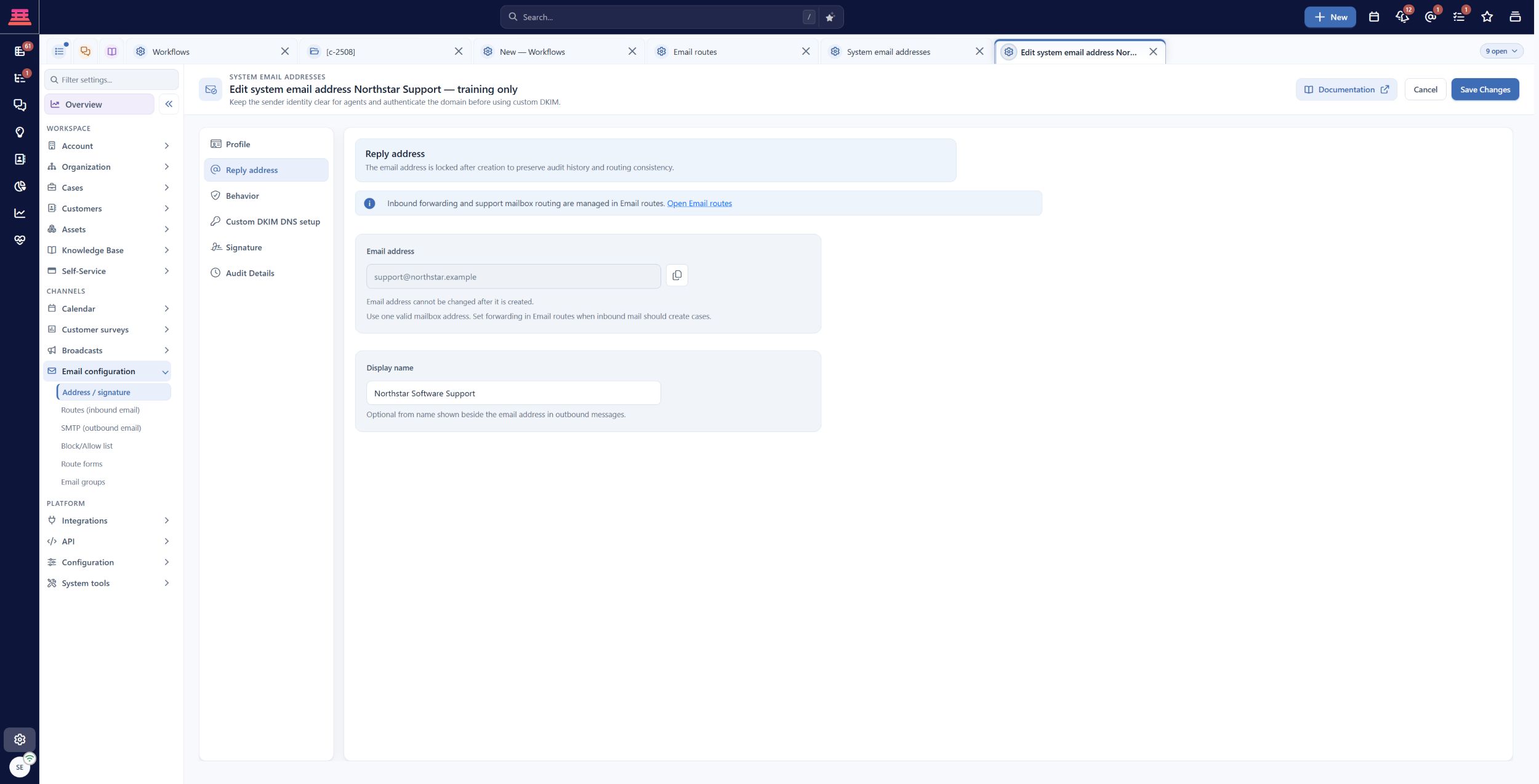
Saved fictional reply address [email protected] with the Northstar Software Support display name. It is inactive and cannot deliver mail.
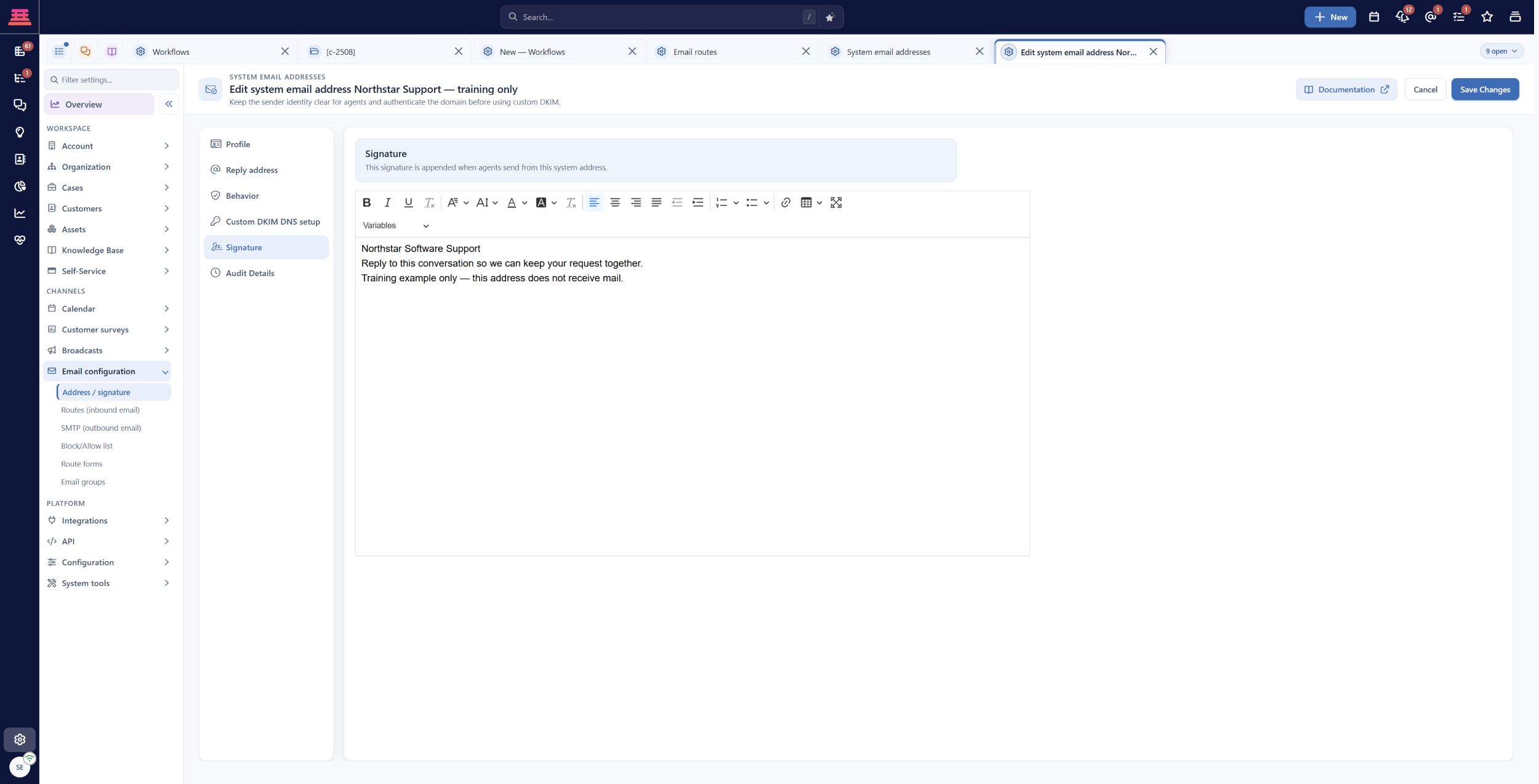
Saved Northstar example signature. Real sending identities should use approved contact information instead of the training disclaimer.
Complete Email Domain Authentication before relying on a new sending domain. Creating this identity does not configure DNS or incoming forwarding. Reply identities and signatures explains the controls.
Verify the full conversation
Send “Monthly report export fails” from the controlled customer mailbox to your real support address. Confirm the new case’s customer, division, priority and queue.
As the agent, inspect Reply Address, To/Cc/Bcc and the complete body before sending. Confirm the received sender and signature in the controlled mailbox. Reply normally from that mailbox and verify that the response appears on the same case.
A saved route proves configuration only. Record delivery and reply matching separately.
Recover common failures
If no case appears, check mailbox forwarding, the exact generated destination and active route. If the shared mailbox becomes the contact, review forwarded-sender handling. If replies create duplicates, inspect references and subject matching with the mailbox administrator.
If the outgoing address is absent, check Active and the actual composer context. If a signature appears twice, review system signature, template and agent sign-off together. If the locked email is wrong, create and verify a replacement rather than changing an unrelated display name.
Completion check
- Inbound forwarding reaches the intended route.
- The outgoing sender and signature are correct.
- A controlled customer receives the reply.
- Their next reply stays on the same case.
- Authentication and delivery evidence is recorded.
Previous: Communication Channels · Next: Email Domain Authentication
Updated 22 minutes ago