

Enabling Escalations
Define an escalation, configure the intended handoff and verify receiving ownership and customer-update responsibility.
Optional · Automate useful work
An escalation brings a case to someone who can provide additional authority, expertise or attention. It should establish a clear next action. Increasing priority alone does not hand the work to a specialist.
Before you begin
Use an administrator permitted to configure escalation types and workflows, and an agent permitted to escalate a case. Agree which queue or person receives the work and who keeps the customer informed. Ensure the receiving staff can access the case’s division.
For Northstar, Harbor’s report-export failure may need engineering investigation after the support agent has gathered the export format, error and reproduction steps. Escalation should carry that context.
Review escalation configuration
- Open Settings → Cases → Escalation types and inspect the available types.
- Reuse a suitable choice, such as the demo’s Software issue. If a distinct process is needed, select New Escalation Type. On Escalation Type Details, enter Name and Description explaining when agents should choose it.
- Review Divisions and Issues. Empty selections mean global/all-issue scope where your access permits it. Restrict a new specialist type only when the process really differs for those cases.
- Choose Type: Escalation for raising the case, or De-Escalation for a handback template. Review Display order and Active escalation type.
- Open Template and write prompts for impact, export format, checks completed, evidence and the help requested. Review any AI-generated draft before using it. Select Save Changes, then reopen the type.
- If routing should happen automatically, open Settings → Configuration → Workflows and review the intended escalation event, requirements and supported assignment actions.
- Keep a new workflow inactive while preparing it. Choose the receiving queue/agent deliberately and review competing rules before activation.
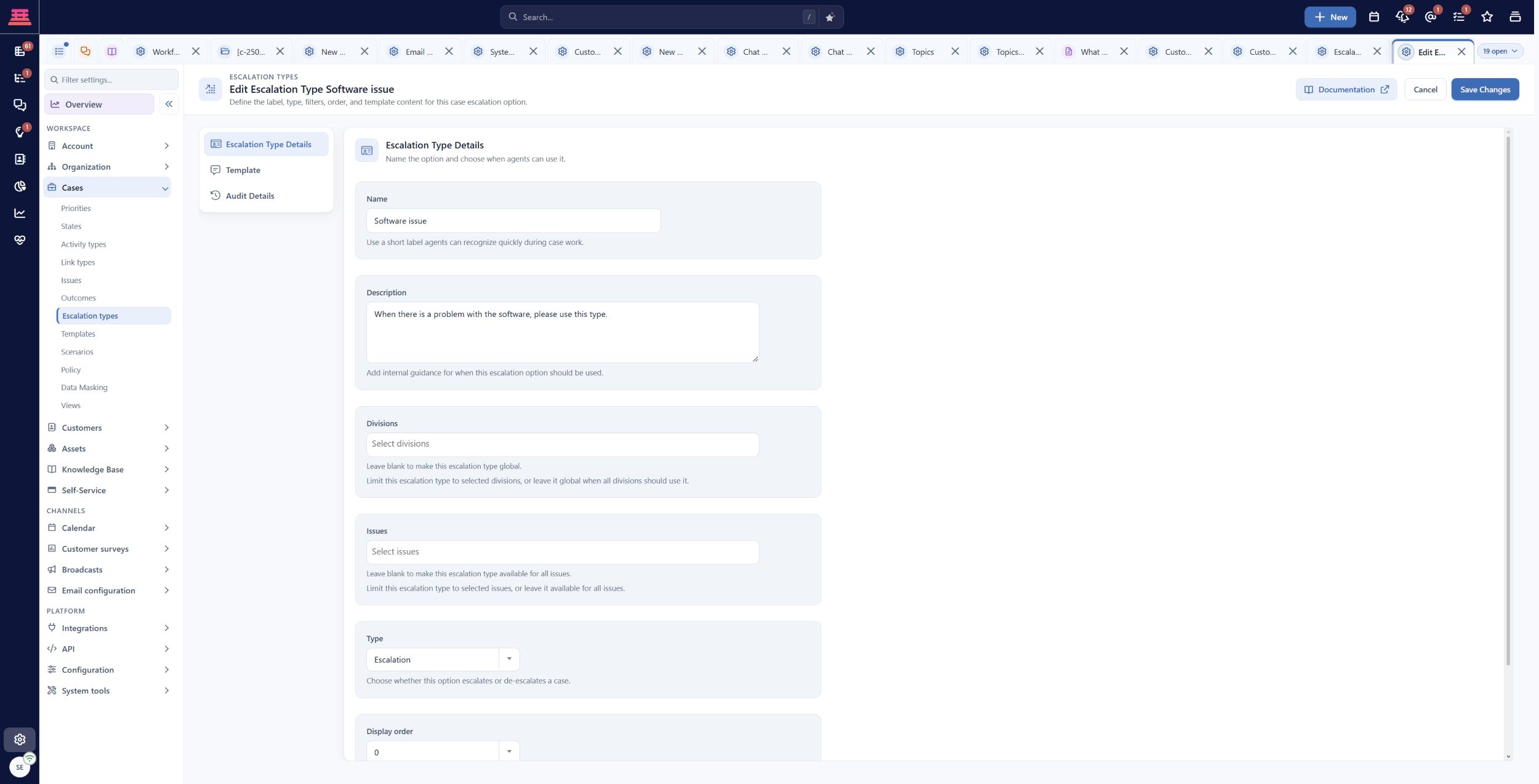
Existing saved Software issue escalation type. It is active and global; reuse a suitable type instead of creating unnecessary choices.
Escalation types and escalation workflow guidance provide the detailed configuration. The older workflow walkthrough should be read alongside the current Core workflow reference.
Perform a useful handoff
- Open the controlled Harbor case and confirm customer, impact, current owner and service deadlines.
- Add an internal note summarizing what failed, what was tested, the evidence and the specific help requested. Do not send private diagnosis to the customer accidentally.
- Open the case’s Actions tab, find Escalations and choose Escalate Case. Choose an Escalation type, enter Details describing the help needed, review attachments and optionally select Add me as a watcher. Select Escalate. This dialog does not choose a destination: routing comes from the configured workflows, or you assign the receiver separately.
- Review the saved case’s queue and owner. A queue destination may leave the case without a named agent until someone accepts responsibility.
- Have the receiving agent open the case, confirm access and identify their next action.
- Keep a named person responsible for the customer update and its due time. Linking engineering work or escalating internally does not itself notify the customer.
- After the specialist’s work, open Actions → Escalations → De-escalate Case. Choose De-escalate to keep the current owner before any configured de-escalation workflows run, or De-escalate to {name} when the originator return option is available. A later escalation may offer Escalate back to {name}. Verify the resulting owner and status; an available return depends on the case’s actual ownership history.
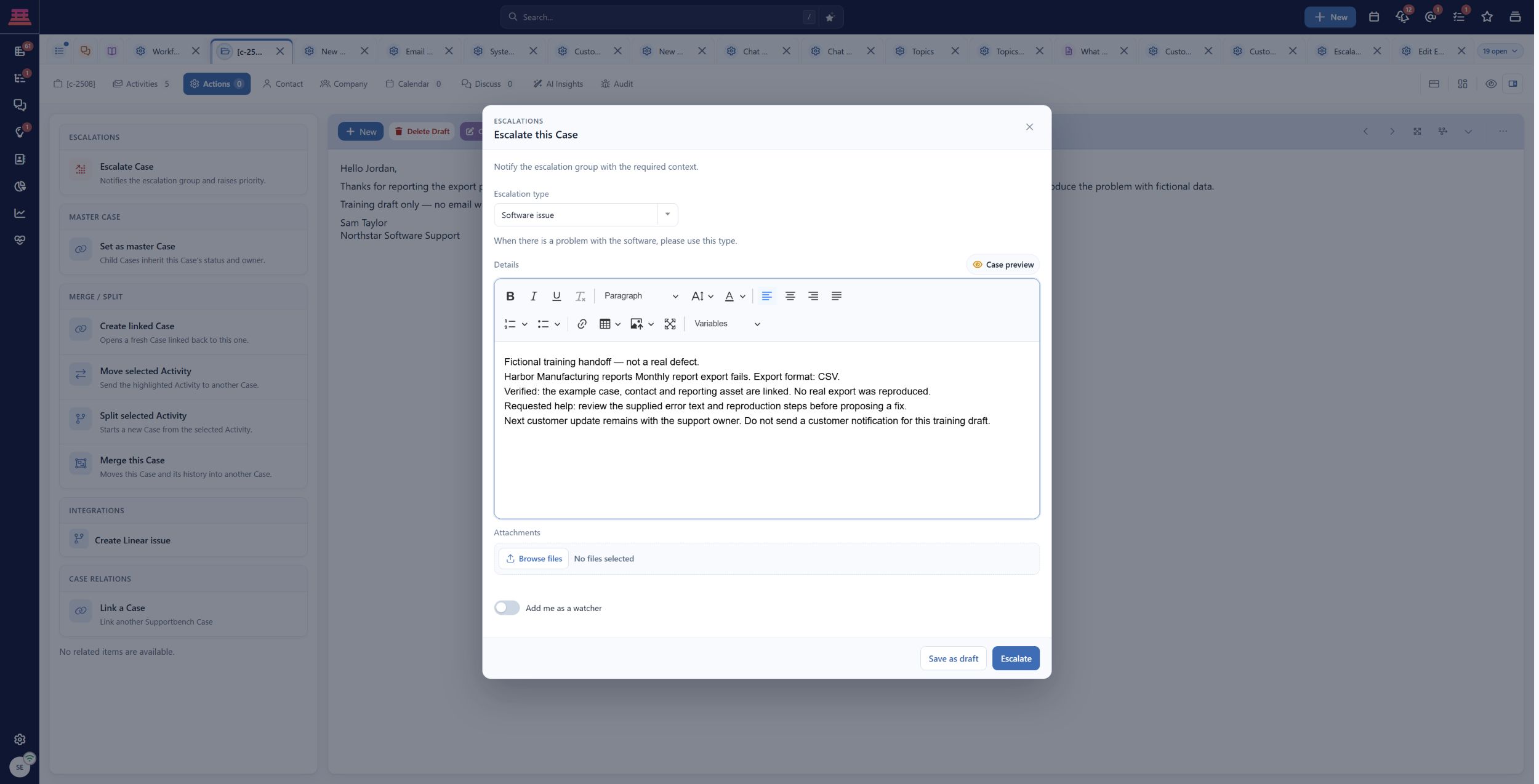
Filled escalation draft for the Harbor training case. Software issue supplies the template; Escalate has not been submitted and routing is untested.
Working a case through resolution explains the operational context.
Test the handoff before relying on it
Use a harmless case to confirm the escalation type appears, the intended routing occurs, the receiving person can read the record and the next customer communication has an owner. Inspect any notification separately if the workflow sends one.
For a simple team, manual assignment with a clear internal note may be sufficient initially. Add automatic escalation only when the trigger and response process are agreed.
Recover common problems
- No escalation action or type: check role permission, type active state and relevant scope.
- Case reaches a queue but no agent: inspect queue monitoring and automatic-assignment eligibility; assign responsibility deliberately.
- Return option is absent: inspect whether the case has a prior named owner and use an authorized assignment path instead of inventing one.
- Wrong final destination: review escalation and subsequent workflow actions.
- Customer heard nothing: inspect the actual reply/notification, recipient and delivery result; internal routing is not a customer update.
Completion check
- The escalation reason and receiver are clear.
- The receiving staff can access the case.
- The handoff includes useful evidence and a specific request.
- Queue/owner and customer-update responsibility are verified.
- Return or completion is checked on the actual case.
Previous: Workflows · Next: Choose and verify AI assistance
Updated 29 minutes ago