

Case Policies
A case policy controls a case form: which fields appear, which are required and how they are organized. It does not replace account-wide login policies or SLA workflows. Review the existing forms before creating a new policy.
Required · Configure case handling
A case policy controls a case form: which fields appear, which are required and how they are organized. It does not replace account-wide login policies or SLA workflows. Review the existing forms before creating a new policy.
Before you begin
Use an administrator permitted to manage case policies. Have the intended division, issue and any custom fields ready. The goal is a form a new agent can complete without guessing.
Northstar needs enough information to investigate Harbor’s report-export failure. Requiring the export format may help; demanding information Jordan cannot reasonably know can prevent a legitimate request.
Review the policy that applies
- Open Settings → Cases → Policy.
- Inspect the existing policy for the operation you want to improve. Different types apply to Case Open, Case Closure, Case View, Portal Open and Portal View.
- If a separate form is needed, select New Policy. Enter a meaningful name and choose the correct type.
- In Summary, review its Division, Issue and order. A policy for one scope does not necessarily apply when you test another.
- Review existing overlapping policies before choosing the new order. Keep the initial setup small and predictable.
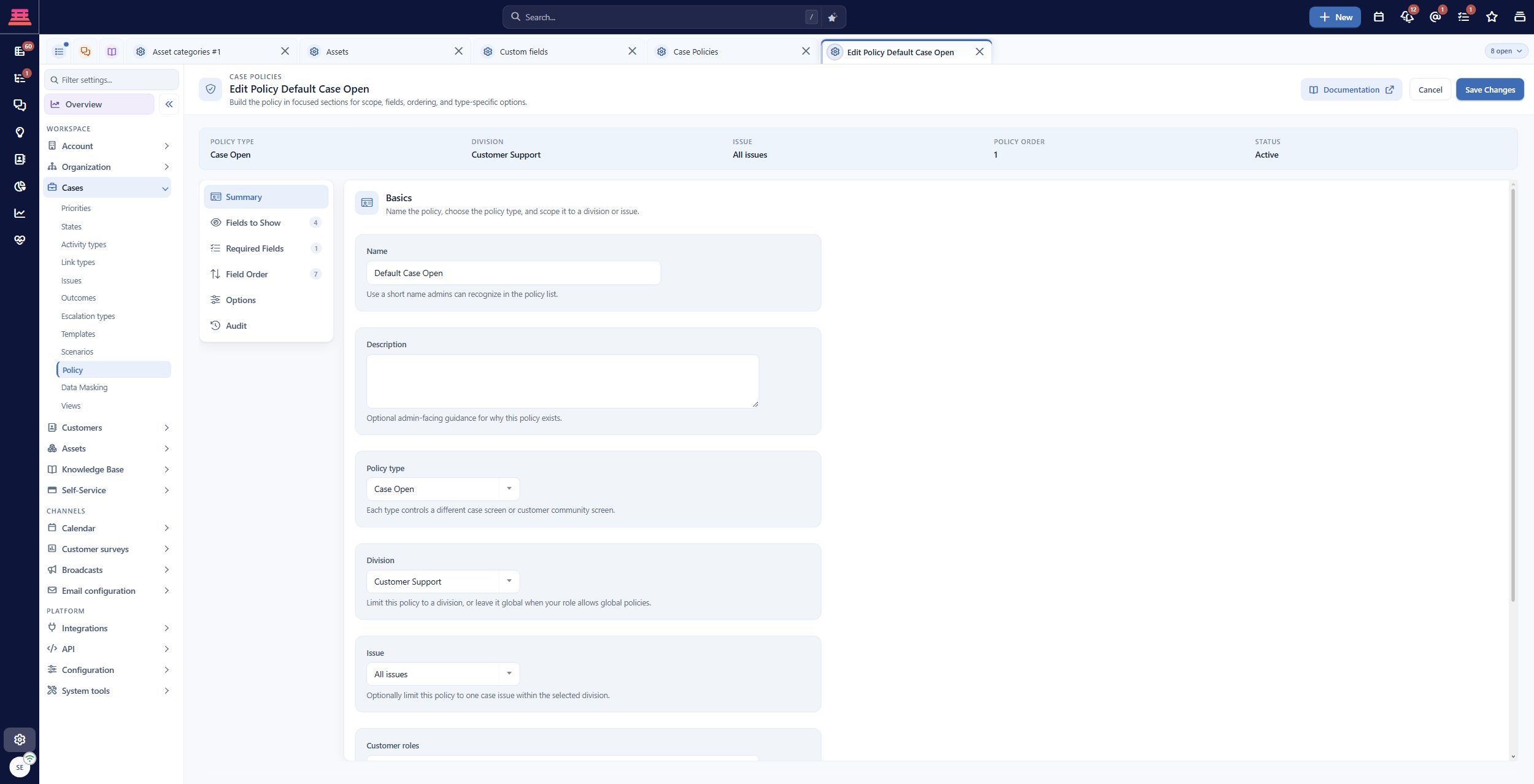
Saved Case Open policy scoped to Customer Support; these demo settings are examples.
Make the form usable
- Open Fields to Show and select the fields the user needs for this task. For case creation, include the customer context and appropriate classification.
- Open Required Fields and require only information necessary at this stage. Every required field must also be shown.
- Add Export format if you created it in the preceding chapter. Consider allowing an unknown answer for first contact, then collecting detail during investigation.
- For a Case View policy, review Summary Fields when that tab is available. Tabs depend on the selected policy type; Case Open does not show this tab.
- Use Field Order to place related questions together. Put identity and the reported problem before optional internal detail.
- Review Options for the selected policy type. Use the settings appropriate to this operation instead of assuming another form’s options have the same effect.
- Select Save Changes, reopen the policy and confirm the saved field lists and scope.
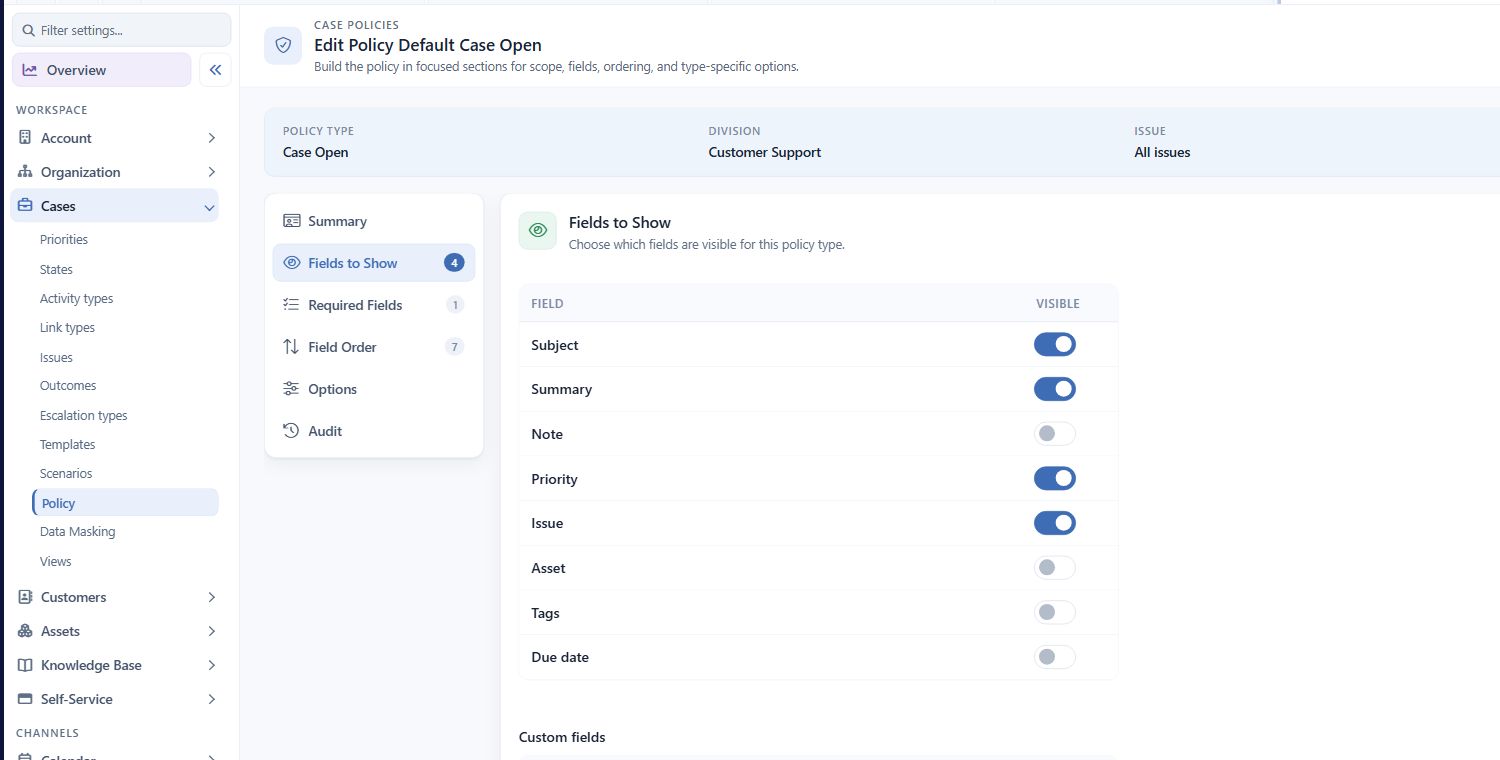
Fields to Show in the saved Case Open policy; required fields are configured separately.
The case-form policy reference explains the individual controls. Custom fields must exist before they can be selected appropriately.
Verify the exact form
- Open a new case as an ordinary intended agent.
- Choose the target division and issue. Confirm the expected fields appear in the intended order.
- Complete every other required field, leave one visible policy-required field blank and select Save draft. Confirm the field is highlighted with a useful validation message and no case is created. This tests the visible client-side validation.
- Discard the unsaved form after this check, or fill the field only when you intend to save the draft. With all required fields complete, Save draft creates a case with a draft activity. Reopen that intended draft and confirm the value remains.
- Repeat for closure if you changed a Case Closure policy.
- If you changed Portal Open or Portal View, test through the actual customer portal with the intended customer identity. An administrator’s agent view is not a substitute.
Recover from confusing forms
If the old form appears, confirm policy type, division, issue and ordering, then reopen the form. If a required field is hidden, fix Fields to Show or remove the requirement. If customers see internal terminology, revise the customer-facing form and labels without assuming the agent form must be identical.
If an existing workflow depends on a field, review that dependency before removing or renaming it. A cleaner form should still provide the information needed to route and resolve the case.
Completion check
- The intended policy type and scope are clear.
- Required fields are visible and answerable.
- The agent can create and read the training case.
- Closure and portal forms were tested when changed.
- Saved values survive reopening.
Previous: Custom Fields · Next: Set service hours and holiday coverage
Updated 1 day ago